Genetics and fitness: how to train for the body you have
Written by Martin Ebner
Updated September 2026

Genetics is the bit of fitness people either ignore completely or blame for absolutely everything. Both are wrong.
Your genes have a huge influence on the body you start with and the one you might eventually build. They affect your frame, proportions, muscle shape, fat distribution, response to training and ultimate physical potential.
That matters. It explains why two people can train equally hard, eat equally well and end up with very different results.
What genetics doesn’t do is hand you an ectomorph workout, an endomorph diet or a mesomorph macro split. The basic principles of effective training remain remarkably similar. The difference is how quickly you respond, which exercises suit your build and where consistent training might eventually take you.
BODY TYPE IS A DESCRIPTION, NOT A PRESCRIPTION
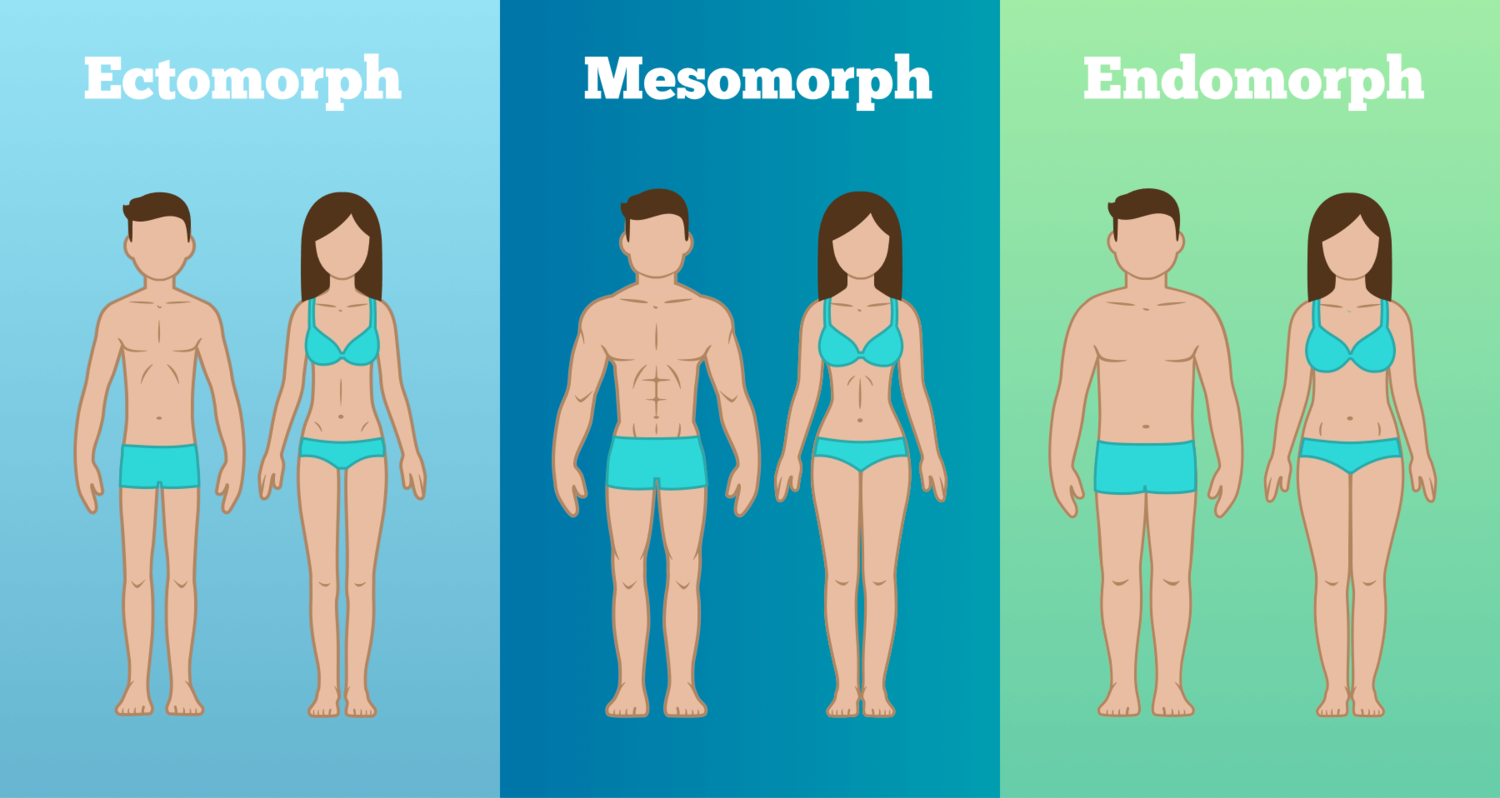
Ectomorph, mesomorph and endomorph can be useful shorthand for visible differences in build. The problem begins when those labels are treated as metabolic diagnoses.
Being naturally narrow doesn’t prove that you have a furious metabolism. Carrying more body fat doesn’t mean you’re destined to gain weight easily, and looking muscular doesn’t guarantee that almost any program will work.
Most people sit somewhere between the categories anyway. Your appearance can also change considerably as you gain muscle, lose fat and get older, which makes a fixed label even less useful.
Your body type may give you a rough description of the frame you’re working with. It can’t tell you exactly how to train, what to eat or where your genetic ceiling sits.
If you came here to identify your type, my guides to male body types and female body types cover that properly. This article deals with the more important question: how much genetics matters and what you can usefully do about it.
WHAT YOUR GENES CAN SHAPE
Your skeleton affects your proportions and how you perform certain exercises. Shoulder width, hip structure, limb length, joint shape and muscle attachments all contribute to how your body looks and moves.
You can build considerably more muscle, become stronger and change your body composition. You can’t alter the width of your pelvis, lengthen a muscle belly or move where a tendon attaches.
That’s why two people can follow the same program, make excellent progress and still look very different at the end of it. Training develops the body you have. It doesn’t replace it with somebody else’s.
WHERE YOU STORE FAT IS PARTLY INHERITED
Genetics influences where your body prefers to store fat and where it tends to lose it first.
A large genome-wide study of body-fat distribution identified hundreds of associated genetic signals, with particularly strong differences between men and women.
You can change how much fat you carry, but you can’t reliably choose the order in which it leaves. Hammering one area with exercises won’t make your body take fat from that exact spot.
Your waist, hips, chest or thighs may change at a different pace from somebody following the same diet. That doesn’t mean the process isn’t working. It means you aren’t working with the same body.
GENETICS AFFECTS BOTH PACE AND POTENTIAL
Some people gain strength and muscle more quickly than others. Some have a greater capacity to build them in the first place.
A meta-analysis of muscle-strength traits estimated that genetic and environmental influences were broadly comparable, although the figures varied considerably between studies. That doesn’t mean half of your personal result was decided at birth. Heritability describes variation across populations, not the precise future of one person.
Research into resistance-training response also finds considerable differences between individuals. A recent systematic review of training responsiveness found wide ranges across strength and muscle-growth studies, while warning that the methods and quality of the evidence were inconsistent.
The useful conclusion isn’t that everyone can achieve exactly the same result. They can’t. It’s that nobody can look at your shoulders, assign you a body type and calculate your potential.
Genetics influences both your pace and your ceiling. The only practical way to discover either is to train properly for long enough to produce evidence.
DON’T TRAIN FOR A TYPE. TRAIN FOR A RESULT
The old version of this article prescribed different repetition ranges, cardio schedules and diets for each somatotype. It was far too neat, and it wasn’t evidence based.
The fundamentals don’t change with the label. You need a program you can repeat, exercises you can perform well, enough challenging work to create an adaptation and a way to progress it over time.
Your goal affects the details. Training for maximum strength isn’t the same as training for muscular endurance, and somebody preparing for a marathon needs more cardio than somebody trying to gain weight. Those are differences in objectives, not body types.
Genetics may influence how much progress that work eventually produces. It doesn’t remove the need to do the work.
USE YOUR BUILD TO CHOOSE BETTER EXERCISES
Your proportions can influence which version of an exercise suits you.
Someone with long thigh bones may find a heel-elevated squat, leg press or different stance more comfortable than a conventional back squat. A long-armed lifter may feel immediately at home deadlifting but need more care with their bench-press setup.
That doesn’t mean avoiding difficult exercises or assuming your build prevents you from doing them. It means choosing movements that train the intended area without forcing your body into a position it dislikes.
For every exercise that isn’t right for you, there are five others we can use instead. The goal is to train the muscle or movement properly, not win an argument about which exercise everybody should perform.
LET YOUR RESPONSE CHANGE THE PROGRAM
Your training record is more useful than a body-type chart.
Give a sensible program enough time to produce evidence. Track the exercises, weights and repetitions, along with anything affecting the session. If changing your body composition is part of the goal, track bodyweight as a trend rather than reacting to every morning’s number.
If you’re progressing, recovering and training with good technique, the plan is doing its job. If progress has stopped, look at training quality, volume, sleep, food and consistency before deciding you’ve reached your genetic limit.
Change one useful variable at a time. Add a repetition, increase the weight, adjust the number of sets or replace an exercise that no longer earns its place. My guide to progressive overload explains how to do that without rebuilding everything every fortnight.
Some people will thrive on more work. Others will progress with less and feel dreadful when they add too much. That difference matters, but you discover it through training and recovery, not by choosing a somatotype from a chart.
EAT FOR THE GOAL, NOT THE LABEL
There’s no ectomorph meal frequency or endomorph macro split.
If you’re trying to gain muscle and your average bodyweight hasn’t moved after several consistent weeks, you probably need more food. If fat loss is the goal and neither your weight nor waist measurement is trending down, your average calorie intake still isn’t producing the required deficit.
That’s information, not a moral judgement.
Your appetite, daily movement and response to a calorie surplus or deficit can all differ from somebody else’s. Adjust your intake according to what happens, not according to a percentage assigned to your body type.
Protein remains important for preserving and building muscle, regardless of your build. My protein guide gives useful ranges without pretending everyone needs the same number.
BE HONEST ABOUT YOUR EXPECTATIONS
Genetics affects what you might realistically achieve. Pretending otherwise doesn’t give anybody more power. It usually leaves them chasing a body that was never available to them and feeling as though sensible progress has somehow failed.
That doesn’t mean lowering every ambition before you begin. Most people never get close enough to their genetic potential to know exactly where it sits.
Train consistently, eat appropriately and give the process time. Your response will gradually tell you whether the original target was realistic, whether it needs longer or whether another goal would make better use of the body you have.
Honest expectations aren’t pessimism. They allow you to recognise excellent progress without dismissing it because you don’t look like somebody who started with a completely different structure.
A DNA TEST WON’T WRITE YOUR PROGRAM
Commercial genetic tests can sound far more precise than the science currently allows. They may report individual variants associated with power, endurance or injury risk, but they can’t reliably turn that information into the best workout for you.
A joint expert statement on genetic testing and exercise prescription concluded that there was no established clinical application for using these tests to prescribe exercise or prevent injury.
Your training history already provides better practical information. It shows which exercises suit you, how quickly you recover, how much work you tolerate and what produces progress.
No saliva sample can replace that.
CELEBRITIES AREN’T BLUEPRINTS
You can admire somebody’s physique without treating it as a promise.
You don’t know their proportions, training history, daily routine, recovery, genetics or what happened before the photograph was taken. Copying their workout can give you ideas, but it can’t give you their body.
Compare yourself with evidence you control. Are you stronger? Are you moving better? Have your measurements changed? Do your clothes fit differently? Can you follow the program without arranging your entire life around it?
Those questions tell you far more than whether somebody on Instagram has similar shoulders.
MAKE THE MOST OF WHAT YOU’VE GOT
Genetics influences the starting point, the pace, the ceiling and how the result looks. Training decides how much of that potential you use.
Start with a sensible personalised training plan, follow it long enough to learn something and adjust it using your own results.
You may never know the exact limits of your genetics. That’s fine. Getting close enough to find out is usually several years of good work away.
If you’ve ever wondered whether your genetics are holding you back or whether your plan simply isn’t giving them much to work with, Check It Oot is where I sort the hard limits from the expensive excuses. One email once or twice a month, written by me, straight to your inbox.