
Pre-workout nutrition: what to eat before training
Written by Martin Ebner,
Last updated October 2026

What you eat before training matters, but not in the way old fitness magazines made it sound. You don’t need a sacred macro split, a meal timed to the minute or an enormous tub covered in lightning bolts.
A decent pre-workout meal can give you energy, help you maintain your performance and stop hunger barging into the session. The wrong meal, eaten too close to training, can turn your warm-up into a negotiation with your stomach.
I don’t believe every workout needs an elaborate pre-workout ritual. You need enough fuel for the work ahead, food you can digest comfortably and timing that suits your day. That’s about it.
WHAT PRE-WORKOUT NUTRITION NEEDS TO DO
Pre-workout nutrition has two jobs. It should support the session and stay out of your way while you train.
Carbohydrates can provide readily available energy, protein helps you cover your wider recovery and muscle-building needs, and fluid matters if you’re starting the workout dehydrated. None of that means you need to cram everything into the final thirty minutes.
What you’ve eaten across the day matters far more than whether your banana arrived at precisely 4.17 pm.
DO YOU NEED TO EAT BEFORE EVERY WORKOUT?
No.
If you ate a decent meal two or three hours ago and you’re heading into a normal strength session, you may already be perfectly well fuelled. There’s no emergency snack required just because you’ve walked through the gym door.
Food becomes more useful when you’ve gone several hours without eating, you’re training first thing in the morning, the session is long or demanding, or you know from experience that your performance drops when you train hungry.
A systematic review and meta-analysis of carbohydrate intake during resistance training found that carbohydrate improved total training volume, with the clearest benefits during sessions lasting longer than forty-five minutes and when the person had fasted for at least eight hours.
That’s a much more useful conclusion than claiming everybody must eat before every workout.
CARBOHYDRATES DO MOST OF THE IMMEDIATE FUEL WORK
Carbohydrates are broken down into glucose and stored partly as glycogen in your muscles and liver. During demanding training, that stored energy helps you continue producing useful work.
This doesn’t make every workout a carb-loading event. A short session performed after normal meals probably doesn’t require extra fuel. A high-volume leg workout, long endurance session or morning workout after an overnight fast is a different matter.
It also doesn’t mean sugar must be avoided before training. Faster-digesting carbohydrates can be useful when you’re short on time. Fruit, honey, bread, cereal or a small amount of juice won’t cause an inevitable crash and destroy your workout.
If you’re preparing for a long event rather than an ordinary training session, my guide to carb loading before a big race covers the bigger picture.
PROTEIN MATTERS, BUT THE CLOCK ISN’T RUNNING OUT
Including protein before training is sensible, particularly if it has been several hours since your last meal. That might mean eggs, yogurt, milk, chicken, tofu or a protein shake.
You don’t need to treat it like a force field against muscle breakdown. Your total protein intake across the day matters far more than whether one serving lands immediately before or after the session.
A recent systematic review comparing protein before and after resistance training found no important difference in lean-mass gains between the two timings. The wider evidence supports spreading useful servings across the day rather than obsessing over one tiny window.
For most people, somewhere around 20 to 40 grams in a meal is a useful range, depending on body size and the rest of the diet. My guide to protein timing for strength gains goes into more detail.
MATCH THE MEAL TO THE TIME AVAILABLE
If you’ve got two to four hours before training, you can eat a normal meal containing carbohydrates, protein and whatever fruit or vegetables fit naturally alongside it. There’s no need to strip the meal down to something joyless.
With sixty to ninety minutes available, a smaller meal or snack usually makes more sense. Oats with protein powder and banana, yogurt with fruit and cereal, toast with eggs, or a sandwich with a lean protein filling can all work.
My protein-packed overnight oats and porridge are both useful options when there’s enough time to digest them. Closer to the session, I’d keep things lighter.
If you’re training almost immediately, a banana, toast with honey, a small bowl of cereal, a few dates or a protein shake may sit more comfortably. Some people can eat a full meal and start squatting an hour later. Others will spend every set being reminded of it.
EARLY-MORNING TRAINING IS ITS OWN LITTLE WORLD
You don’t have to force down breakfast at six in the morning if the thought makes you feel sick.
If the session is short, you feel good and your performance holds up, training before breakfast can be perfectly reasonable. It isn’t automatically better for fat loss, and it isn’t a badge of honour either.
If you feel flat, hungry or unable to train properly, try something small and easy to digest. A banana, a little toast, some yogurt or a shake may be enough. You can eat a proper breakfast afterwards.
I’ve covered the evidence more fully in fasted versus fed weight training.
FAT AND FIBRE AREN’T BAD, BUT TIMING CAN MATTER
The old article told readers to avoid saturated fat like the plague. That’s melodramatic and not particularly useful.
Fat and fibre can slow digestion, which is usually no problem at all. Very large amounts immediately before hard training may leave some people feeling heavy, bloated or uncomfortable.
The same applies to enormous portions, unfamiliar foods and anything you already know your stomach dislikes. Save the culinary experimentation for a day when you’re not planning to put a loaded bar across your back.
CAFFEINE CAN HELP, BUT MORE ISN’T ALWAYS BETTER
Caffeine can improve several aspects of exercise performance, although the response varies considerably between people. The International Society of Sports Nutrition’s position stand found benefits across strength, muscular endurance, sprinting and aerobic exercise in many, but not all, studies.
You don’t need an aggressive dose to have a productive workout. There’s a point where alert becomes wired, and wired isn’t the same as strong.
Timing matters as well. If caffeine before an evening session damages your sleep, the trade probably isn’t worth it. A slightly livelier workout doesn’t compensate for lying awake at midnight staring at the ceiling.
WHERE PRE LAB PRO FITS
A pre-workout supplement is optional. It won’t replace food, sleep, hydration or a training program that makes sense.
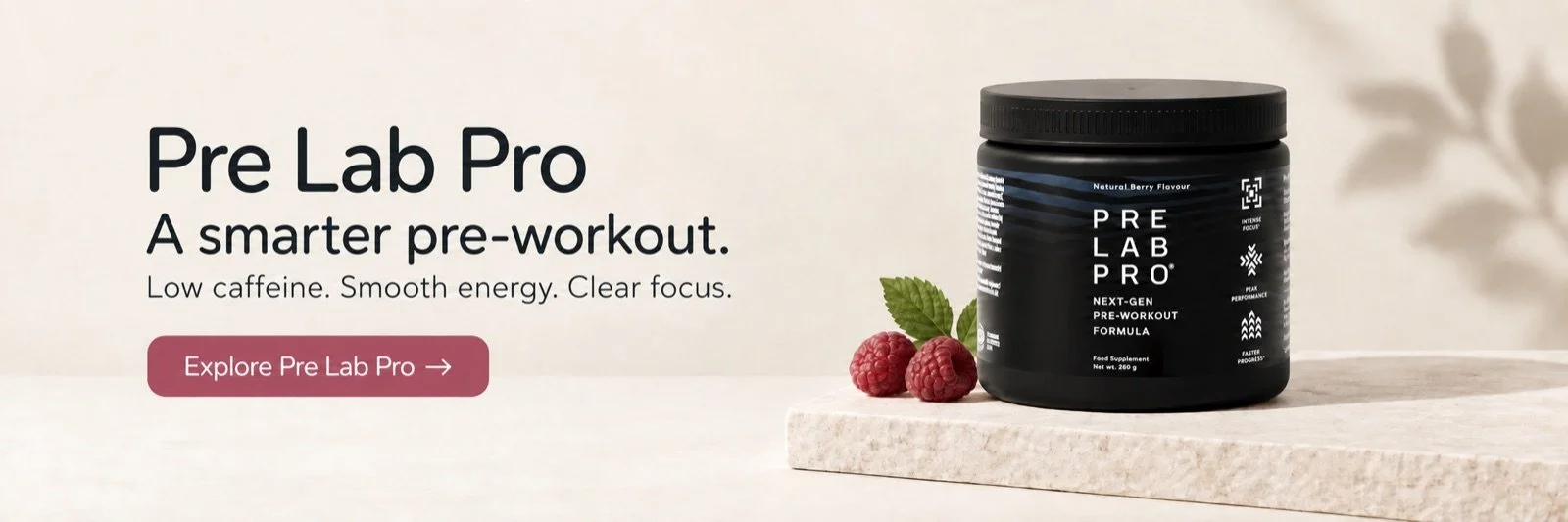
If you want a ready-made option, Pre Lab Pro is the one I’m comfortable recommending. One serving contains 80 mg of caffeine, which is much more restrained than many high-stimulant products, alongside L-theanine and several other ingredients aimed at training performance.
I still wouldn’t take it automatically before every session. Use it when it adds something, and pay attention to how you respond.
AFTER THE WORKOUT
You don’t need to sprint towards a protein shake the second the final set ends.
If you ate in the hours before training, you’ve got time to shower, travel home and eat a proper meal. If you trained after a long fast or won’t be eating for several hours, getting some protein and carbohydrates afterwards becomes more useful.
My guide to post-workout nutrition covers that side of the session.
EAT ENOUGH TO TRAIN, NOT SO MUCH THAT YOU CAN’T
The perfect pre-workout meal doesn’t exist. The best choice is the one that gives you enough energy, digests comfortably and fits the time available.
Start with familiar food. Adjust the amount and timing according to the session. Notice what happens to your energy, performance and stomach, then use that information next time.
That’s far more useful than following somebody else’s meal plan as though your digestive system signed the same contract.
If you’ve ever eaten the supposedly perfect pre-workout meal and spent your first set negotiating with your stomach, Check It Oot is where I sort useful nutrition advice from the stuff that only works on paper. One email once or twice a month, written by me, straight to your inbox.