
The 5 best bulking supplements for hardgainers
Written by Martin Ebner
Updated Sept 2026
I like supplements, but I don’t believe in pretending they’re more important than they are. They can make a good diet easier to follow, improve the quality of your training and fill a genuine nutritional gap. They can’t rescue a poor program or compensate for consistently eating too little.
That distinction matters for hardgainers. If your bodyweight hasn’t moved for several weeks, the problem probably isn’t that you’re missing a secret powder. You’re either not eating enough, not training effectively or not recovering well enough to adapt.
Once those foundations are in place, a few supplements can make the process easier. These are the five I’d consider first.
BEFORE YOU BUY ANYTHING
Start with your food and training. You need a manageable calorie surplus, enough protein, progressive resistance training and a reasonable amount of sleep. Supplements sit on top of that foundation, not underneath it.
My hardgainer’s guide to building muscle covers the full process, while the macro-counting guide will help you work out whether you’re eating enough consistently.
If those pieces aren’t in place, spend your supplement money on food.
1. PROTEIN POWDER
Protein powder isn’t inherently better than chicken, eggs, dairy, fish, tofu or any other quality protein source. It’s simply easier to drink a shake than prepare another meal, especially when you’re already struggling to eat enough.
A large systematic review and meta-analysis found that protein supplementation can improve gains in muscle size and strength during resistance training. The benefit appears to level off once total daily protein intake reaches roughly 1.6 grams per kilogram of bodyweight for most people.
That doesn’t mean everyone needs exactly the same amount. It gives you a useful target without turning every meal into an accounting exercise.
Whey is convenient, well researched and rich in essential amino acids. Soy and good-quality plant-protein blends can also do the job if you’re vegan or don’t tolerate dairy well. Choose something you digest comfortably, enjoy drinking and can afford to use consistently.
You don’t need to sprint towards a shaker the second your final set ends. Use protein powder whenever it helps you reach your daily target.
2. CREATINE MONOHYDRATE
Creatine monohydrate is the easiest recommendation on this list. It’s one of the most extensively studied sports supplements available, and it can improve strength, training performance and gains in lean mass when combined with resistance training.
A 2024 systematic review and meta-analysis found that adding creatine to resistance training produced greater gains in lean body mass than training alone. The effect isn’t miraculous, but it’s meaningful enough to justify the small cost and effort.
Take three to five grams every day. You don’t need to cycle it, split it around your workout or buy an elaborate blend. The ordinary monohydrate form is the one with the strongest evidence.
You may gain some weight quickly when you begin using it because creatine draws additional water into the muscles. That isn’t fat, and it doesn’t mean you’ve suddenly built several kilograms of new muscle.
3. A MASS GAINER OR HOMEMADE CALORIE SHAKE
A mass gainer doesn’t contain a special form of muscle-building energy. It’s simply a convenient combination of calories, carbohydrate and protein.
That can still be useful. If you’re maintaining your weight despite trying to bulk, liquid calories are often easier to manage than forcing down another large meal. The problem with commercial mass gainers is that the advertised serving can be enormous, expensive and far beyond what you need.
Check the serving size rather than being impressed by the biggest number on the label. You’re looking for enough additional energy to move your weight gradually, not a thousand-calorie ambush that leaves you bloated and replaces proper meals.
You can also make your own with milk or a dairy-free alternative, oats, banana, nut butter and protein powder. It’s usually cheaper, easier to adjust and tastes like something you chose voluntarily.
Start with a modest serving and watch the trend in your bodyweight. If nothing changes after two or three weeks, add a little more.
4. A PRE-WORKOUT YOU’LL USE SENSIBLY
Pre-workout doesn’t build muscle directly. Its job is to help you arrive at the session alert, focused and ready to train.
Caffeine can improve muscular endurance, movement speed and strength in some people, although individual responses vary. Even relatively low doses may offer a small performance benefit, so you don’t need enough caffeine to hear colours.
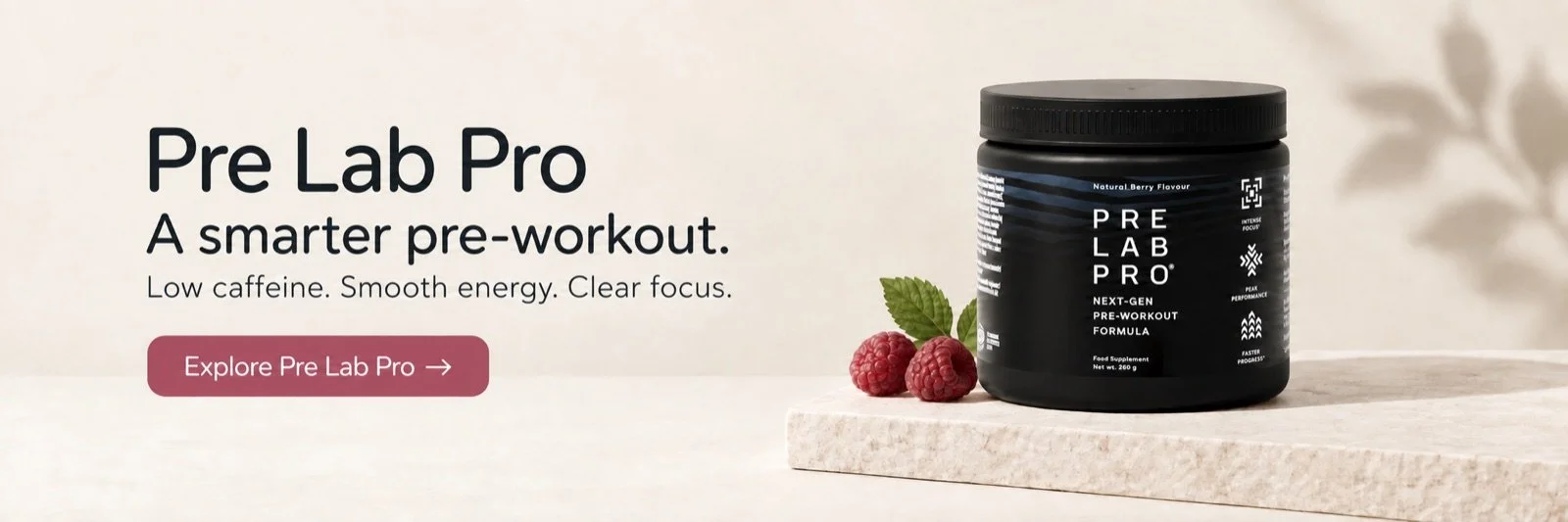
Pre Lab Pro is the option I’d use for someone who wants a lower-caffeine formula. It provides 80 milligrams of caffeine per serving, alongside L-theanine, L-tyrosine, beetroot and its citrulline-glutathione blend. That makes it a more measured choice than the heavily stimulated formulas that leave some people feeling dreadful.
It still contains caffeine, so timing matters. Don’t take it late in the day if it affects your sleep, and don’t assume you need it before every session. A pre-workout is useful when it improves your training without damaging your recovery.
5. A MULTIVITAMIN, IF YOUR DIET NEEDS ONE
A multivitamin isn’t a muscle-building supplement. It won’t create a calorie surplus, increase training volume or replace fruit and vegetables.
It can provide some insurance when a high-calorie diet becomes repetitive and food quality begins to slip. Hardgainers sometimes become so focused on hitting calories that variety disappears, which isn’t a good long-term strategy.
The first solution is to improve the diet. If you still want additional cover, choose a sensibly dosed product rather than something offering heroic quantities of every vitamin it can fit on the label.
I’ve reviewed Performance Lab NutriGenesis Multi separately. It’s worth reading if you’re considering a multivitamin, but don’t mistake covering a nutritional gap for stimulating muscle growth. If you already know it suits your needs, you can view NutriGenesis Multi for Men directly.
If you suspect a genuine deficiency, get it investigated rather than guessing and swallowing increasingly expensive tablets.
WHAT DIDN’T MAKE THE LIST
BCAAs don’t offer much to someone already consuming enough complete protein. The amino acids required for muscle growth are already present in whey, dairy, meat, eggs, soy and properly formulated plant-protein blends.
Collagen has uses, but it isn’t an equal substitute for whey, soy or another complete protein when muscle growth is the priority. It contains relatively little leucine and lacks the full essential-amino-acid profile needed to stimulate muscle protein synthesis effectively.
Testosterone boosters also aren’t general bulking supplements. A systematic review found that most of the ingredients marketed as testosterone boosters failed to increase total testosterone. If you think you have symptoms of low testosterone, speak to a medical professional and get your levels checked.
THE STACK I’D USE
For most hardgainers, I’d keep things simple. Use creatine every day, add protein powder when food alone isn’t getting you to your target, and use a calorie shake if eating enough remains the main obstacle.
A pre-workout is optional and should earn its place by improving your sessions. A multivitamin only makes sense when it addresses a realistic gap in the diet.
That’s it. You don’t need a cupboard full of tubs, a supplement timetable or something different for every hour of the day. Spend most of your attention on training well, eating enough and repeating both for long enough to see what happens.
If you like fitness advice that tells you what’s worth buying and what can stay on the shelf, subscribe to Check It Oot. It arrives once or twice a month, with useful training and nutrition ideas, honest reviews and the occasional left turn into something I’ve found interesting.